
Blog entry by Astrid Dinneen
Anyone in the world
Designed by Hampshire EMTAS, the EAL Excellence Award is a comprehensive self-evaluation framework that helps schools monitor the impact of their provision for pupils learning English as an additional language (EAL) and address wider aspects of minority ethnic achievement. Covering five key areas - Leadership and Management, Pedagogy and Practice, Data, Assessment and Progress, Teaching and Learning and Parental and Community Engagement - the award originally featured three levels: Bronze, Silver and Gold.
However, as schools continued to use the framework to drive sustained improvement, a need emerged for a fourth level to recognise excellence consistently demonstrated at Gold across multiple validations. This blog explores the journey of the award through Merton Infant School’s own experience, offering insights into what sustained excellence looks like in practice.
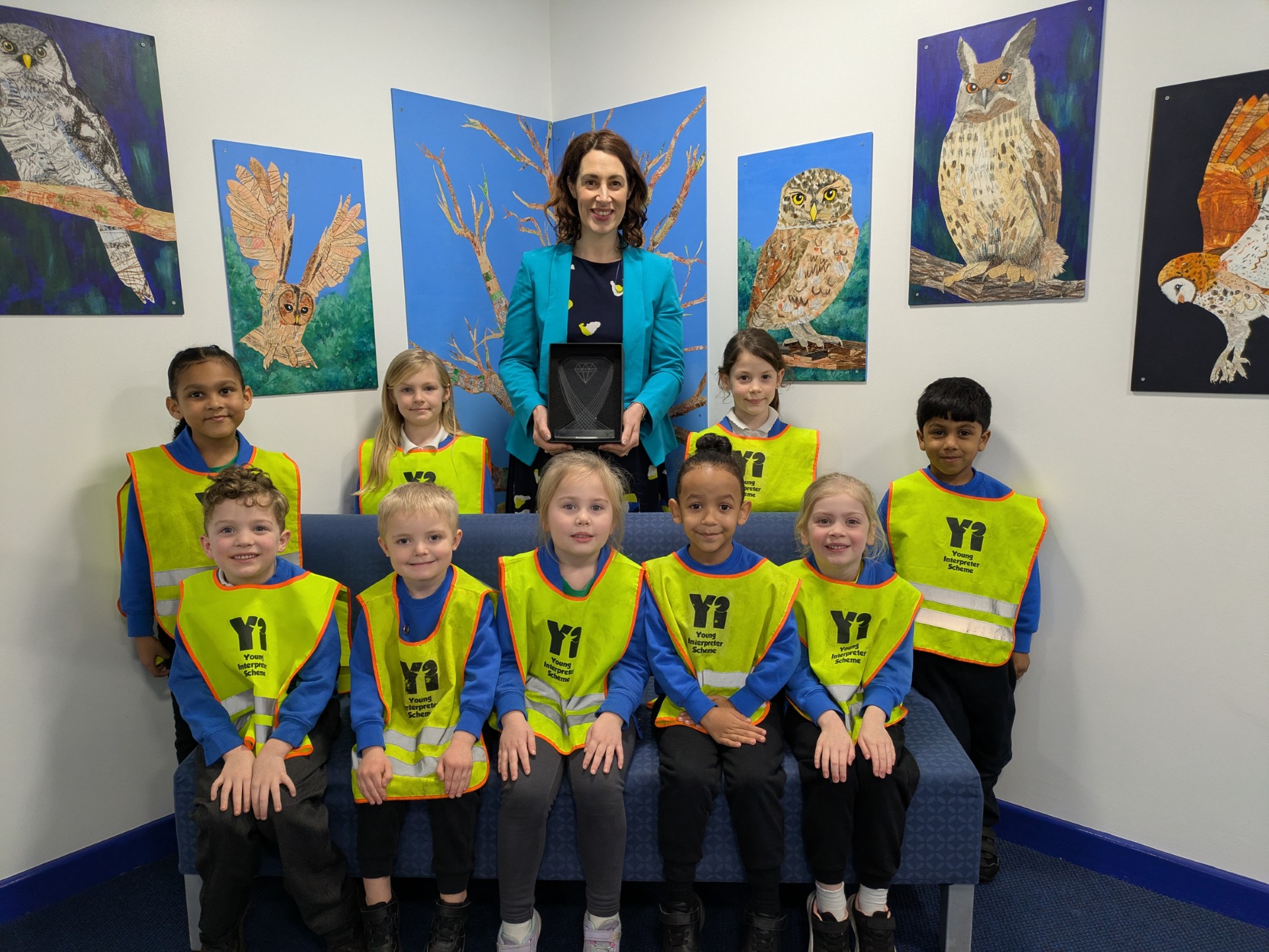
Merton Infant School's EAL lead Mrs Relf and the Young Interpreters celebrate their Diamond Award
How did the Merton Infant School’s EAL journey start?
Merton Infant School’s journey began over a decade ago, when EAL was identified as a whole-school priority due to the increasing number of multilingual children joining the school. From the outset, the school worked closely with EMTAS, seeking advice on meeting the needs of multilingual learners, arranging whole-staff training and introducing the Young Interpreter Scheme.
In 2019, the school undertook its first award validation and achieved Bronze. Their EAL journey continued under the leadership of their EAL Co-ordinator, who ensured staff training remained current and provision was consistently maintained across the school. Acting on guidance from their initial validation, the school progressed to Gold in 2021. When they successfully renewed their Gold award in 2023, Headteacher Mrs James posed an important question: “What’s next for us?”
And so, the Diamond Award was born.
What is the EMTAS Diamond EAL Excellence Award and how do schools achieve it?
Working with Merton and other Hampshire schools that had reached similar milestones in their EAL journeys, EMTAS developed the Diamond level to acknowledge schools that not only maintain Gold standards but also act as centres of expertise, extending their impact into the wider community.
To qualify for Diamond, schools must achieve Gold across two consecutive validations and provide evidence of work in at least one of the following strands:
Community - engaging with families across the wider catchment
Collaboration - working in partnership with other schools
Contribution - supporting EMTAS initiatives and developments.
The Diamond Award was launched in 2024: Working beyond Gold – introducing the new EMTAS Diamond EAL Excellence Award.
How did Merton Infant School achieve Diamond?
In 2025, led by their new EAL Co-ordinator, Mrs Relf , Merton Infant School became the first school in Hampshire to achieve the Diamond EAL Excellence Award. To meet the Diamond criteria, Mrs Relf provided evidence in not one but two strands: Collaboration and Contribution. She mentored EAL Co-ordinators in other schools on their own EAL award journeys and worked with EMTAS to help shape the Diamond Award itself, as well as contributing to new content for the Young Interpreter Scheme.
The school also demonstrated that Gold standards had been consistently maintained since their previous validation. A key focus was consolidating the Leadership and Management strand by further embedding EAL into school policies and aligning it with the school’s core values: Motivation, Excellence, Respect, Teamwork, Opportunities and Never Give Up. The Pedagogy and Practice and Teaching and Learning strands remained strong, with EAL embraced by all staff. In addition, much work had focused on the Parental Engagement strand.
In response to parent voice gathered through EAL coffee events and annual questionnaires, families expressed a desire to play a more active role in sharing their cultures with the school. This led to the creation of Culture Day, with multilingual parents and staff invited to lead activities in school. The response was overwhelmingly positive, strengthening partnerships with families, many of whom have already volunteered to take part again next year.
Merton Infant School has been using a ‘Language of the Half Term’ approach since 2016. When Mrs Relf took on the role of EAL Co-ordinator, she refined and adapted the initiative to strengthen its impact. Children are now recognised as language experts and are invited to lead whole-school assemblies, allowing their peers to hear authentic pronunciation directly from one another. This peer-led approach promotes confidence, respect and inclusion.
Parents are actively involved, with families invited to check the accuracy and pronunciation of multilingual words, helping to ensure cultural and linguistic authenticity. Where possible, parents are also invited to attend launch assemblies to share their first-hand knowledge of the language. These contributions are warmly acknowledged and reinforce the school’s belief that families’ languages and cultures are valued and respected.
To support cognitive load, the amount of language taught has been carefully reduced, reflecting the principle that less is more. Previous languages are regularly revisited when new ones are introduced to support children’s long-term memory. As a result, by the end of the Summer term last year, pupils were able to confidently greet others in six different languages and identify where each language is spoken around the world.
To further reinforce the connection between spoken and written language, children are encouraged to write labels and captions in their own language so they can see their language represented in print. This was also set as a whole-school homework challenge, with many children taking part. Their work was proudly displayed across the school to celebrate linguistic knowledge and family involvement.
Following a suggestion from the EAL governor, key areas of the school environment are also labelled using the Language of the Half Term to enable children to see and engage with the language in meaningful contexts across the school. This inclusive approach is now part of everyday practice and extends into whole-school events such as productions, where children are encouraged to showcase the school’s linguistic diversity. When sharing messages such as Merry Christmas, Happy Diwali or thank you, children speak first in their own language. These small but meaningful moments send a powerful message of respect and belonging to children and families alike.
How did achieving Diamond impact the school as a whole?
Merton’s successful validation coincided with changes to the Ofsted framework, which now includes reference to early-stage learners of English as an additional language (page 20). In a twist of fate, Ofsted inspectors visited Merton Infant School on the very same day as their Diamond validation.
Inspectors were impressed by the school’s strong EAL leadership and parental engagement. During the inspection, Mrs Relf met with the inspector and spoke passionately about the school’s commitment to its multilingual families, from the moment registration forms are completed through to families becoming a valued part of the Merton community. The school’s culture is built on the belief that if provision is right for SEND and EAL families, it is right for everyone. Creating a welcoming environment where children and families feel a strong sense of belonging and are supported to thrive is central to this ethos.
This was evidenced through systematic book monitoring, questionnaires, governor monitoring visits, curriculum monitoring reports and parent feedback. Most powerful of all, however, was the pupil voice. Inspectors commended the children’s passion and maturity as they spoke confidently about their school and their experiences within it.
In their November 2025 report, Ofsted inspectors wrote:
Being a pupil here is like belonging to a big family with relatives all around the world. Whenever pupils join, great care is taken to settle them into school life. New arrivals who speak English as an additional language (EAL) are admirably supported by ‘young interpreters’. The diversity of the school community and the many home languages spoken are widely celebrated.
[...]
An unwavering focus on fairness and opportunity permeates the school. Pupils who speak EAL have an exceptional start to their education. Explicit teaching of speaking and listening skills and what words mean are part of everyday practice from early years upwards. Carefully considered resources and going over learning before or revisiting it after lessons support EAL pupils’ understanding.
What does it mean to have achieved Diamond level?
Achieving Diamond level officially recognises Merton Infant School as a centre of EAL expertise. This status goes beyond internal excellence - it positions the school as a leader in supporting others.
In the Autumn term 2025, EMTAS called upon Mrs James and Mrs Relf to co-deliver an online network meeting focused on the changes to EAL in the new Ofsted framework. Practitioners from across Hampshire working in different phases learned from Merton’s experience of the updated framework and how they successfully embedded EAL into whole-school practice. Colleagues came away feeling inspired by Merton’s work including the ‘Language of the Half Term’ idea, which other schools have since started to adapt for their own settings.
Coming soon, schools embarking on their Young Interpreter journey across the UK (and beyond) will be able to hear from Mrs Relf’s perspective of running the scheme at Merton Infant School in brand new video material uploaded to our Moodle. Practitioners will also hear from Merton’s Young Interpreters themselves!
What’s next for Merton Infant School?
Both Mrs James and Mrs Relf have reflected that achieving the Diamond Award is not an end in itself. EAL remains a core principle woven through everyday practice, one that is embraced by the whole school community. Work is continuing to maintain high standards, keep up with current approaches such as the Talk Rich Teaching Toolkit and support colleagues across the Hampshire EAL network.
Looking ahead, the Merton team is extending its expertise to Merton Pre-school, where a bespoke version of the EAL Excellence Award will shape provision for multilingual children under four years of age. We look forward to hearing how EAL continues to develop in the Merton community.
With thanks to Mrs James, Mrs Relf, staff, parents and children at Merton Infant School.
[ Modified: Thursday, 26 February 2026, 9:41 AM ]