
Blog entry by Astrid Dinneen
Anyone in the world
By EMTAS Team Leader Dr Sarah Coles
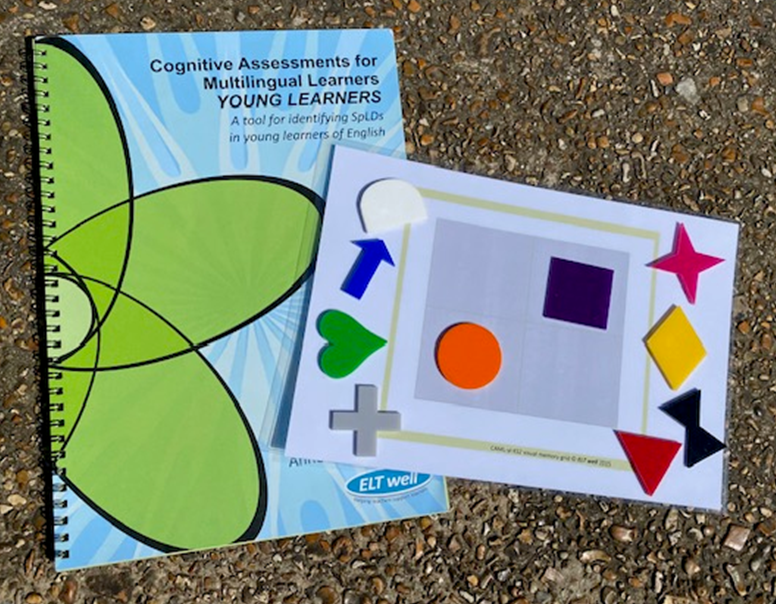
The CAML Key Stage 2 ‘shapes in boxes’ task materials
It is widely accepted that learning English as an additional language is not a special educational need in and of itself. That said, there will be a proportion of multilingual learners in any school who have both sets of needs. Sometimes, this is clear-cut – for example where there is a diagnosis already in place. In such cases, practitioners can be more confident that their multilingual learner does indeed have SEN and they can work to support both those needs and the child’s EAL needs. However, in other cases, the root cause of a child’s lack of progress with their learning may not be so apparent.
For monolingual, English-only children, SENDCos will be familiar with a range of assessment tools and approaches they can use to help identify the nature of the child’s SEND. But for our multilingual learners, many of those tools are not appropriate due to linguistic and/or cultural differences that render them unreliable. So what exists for our multilingual learners that doesn’t leave them out in the cold?
The EMTAS Specialist Teacher Advisor team has recently been trained to use ELT Well’s ‘Cognitive Assessments for Multilingual Learners’ resource, which we shall henceforth shorten to ‘CAML’. CAML comprises a set of tasks which are designed to be free of linguistic and cultural biases. Alongside background information about the child and tracking of their progress over time in acquiring English as an additional language, the CAML tasks can be used to help build a cognitive profile of multilingual learners and determine what interventions might be useful.
The tasks cover such aspects as the development of literacy practices, auditory and visual memory, speed of processing and phonological awareness. They are simple to deliver though EMTAS teachers have found that to do the whole suite in one sitting might be overwhelming and better engagement can be achieved by doing them over two or more sessions.
Each task comprises a short practice, to familiarise the child with what they need to do. Once they are ready, they progress to the full task, many of which are timed. Outcomes are in the most part quantifiable and in the CAML materials, there is guidance to interpret a child’s performance. For example, in one of the memory tasks, ‘shapes in boxes’, the child is briefly shown a shape placed in a grid. The task is for them to choose the right shape from a selection and put it on a grid, replicating what they saw. The task gets progressively more challenging as the child is next shown two shapes, then three, and the guidance includes the number of shapes a child of that age might reasonably be expected to get right. There are several tasks that focus on each area, so results can be cross-checked, enabling practitioners to have more confidence in any conclusions they may draw from the exercise.
So far, our findings from using the CAML with children in schools have highlighted both strengths and areas of weakness. Whilst the CAML is not intended to be a diagnostic tool, we hope that our findings will result in more multilingual children receiving support that is appropriate to their particular needs, both EAL and SEN.
If you have concerns about a multilingual child’s progress, the first thing to do is read the guidance on the EMTAS website: Steps to take when concerned about progress of EAL pupils | Education and learning | Hampshire County Council. If having done that you’re still not sure you’ve nailed it, contact EMTAS@hants.gov.uk to discuss how we might work with you to establish if the underlying cause of concerns about a child at your school are to do with EAL or SEND – or a bit of both.
Further reading: EAL & SEND | EMTASMoodle
[ Modified: Thursday, 23 April 2026, 2:43 PM ]