
Blog entry by Astrid Dinneen
Anyone in the world
By Deputy Team Leader Claire Barker
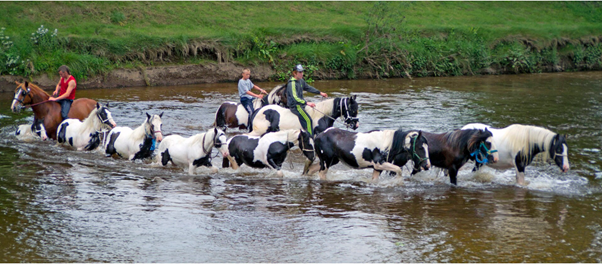
Horse washing in the River Eden at Appleby Fair. Image courtesy of Wikimedia Commons
This blog explores the importance of horse fair season, which runs from May until October. It suggests ways to bring aspects of Traveller culture into the school curriculum and highlights opportunities to celebrate Gypsy, Roma, Traveller History Month (GRTHM).
British rural life has featured local markets for centuries, originating as farmers’ markets where livestock was bought and sold. In the past, horses were central to agriculture, transport and trade and were considered valuable assets. Over time, some of these farmers’ markets became meeting places for people from the Romany and Traveller communities to meet and trade horses.
Today, the fairs still exist as commercial and cultural gatherings where Traveller families meet, news is exchanged, wares are sold and horses are traded. Here, we take a closer look at three well-known horse fairs.
Appleby (Cumbria)
Appleby Horse Fair first began in 1775 and is thought to be one of the oldest markets still being held annually. It started as a livestock market mainly for sheep, cattle and horses and was held outside the town boundary. Unlike other horse fairs, Appleby continues by long term tradition and customs unlike some of the other fairs that were granted a Royal Charter giving them Royal assent to hold the fair.
Due to changes in both agricultural practices and transport, especially the coming of the railway, farmers moved their trade to elsewhere in the county but around the same time the Romany and Traveller communities took over Appleby Fair as a gathering point in their annual calendar and it became a specialist horse fair. By the 20th century, Appleby was established as the main horse fair event of the year for Romany Gypsies and Travellers. This fair has always been held in early June when many Travellers traditionally were on the move and grazing was at its optimum, making it a good time for horse trading. These days, it is the largest Romany Gypsy and Traveller gathering in Europe.
Appleby reinforces identity and cultural ties for Romany and Traveller communities, its significance to them being far greater than the market and horse-trading opportunities it offers.
Stow Horse Fair (Gloucestershire)
There are two Stow Horse Fairs, one on the Thursday nearest 12 May and one on the Thursday closest to 24 October. These two fairs traditionally open and close the horse fair season.
In 1476, King Edward IV granted a Royal Charter for two five-day fairs a year. Over time, this pattern has evolved into two one-day fairs. Families usually travel up the day before and pack up the day after. This fair was originally a sheep fair as this was the main industry of the Cotswolds. As the pastoral economy changed with the agricultural revolution in mid-17th to late 19th centuries, so did the fair and its main focus became horses. Over the years, the horse fair has become a traditional Romany and Traveller horse fair where families meet to socialise, trade horses and hold a market.
Wickham Horse Fair (Hampshire)
This fair is held on 20 May every year unless it falls on a Sunday when it will be held on 21 May.
This fair originated in medieval times around 800 years ago. Like the other fairs, it started as an agricultural fair reflecting the local economy. Henry III granted a charter for a weekly market to be held in the village square and over the years, it has become an annual market and event for Romany Gypsies and Travellers.
Today it includes a mixture of cart driving and racing, fun fair rides and stalls as well as horse trading.
The fair takes over the village square and adjacent road where the racing and showing of horses take place. The street market sells all sorts of goods from furnishings and horse equipment to clothing and china. The village square hosts funfair rides and catering stalls, adding to the lively atmosphere.
The fact that the horse fairs continue to take place and to thrive denotes the continuity of heritage and visibility of Traveller cultures. The fairs have evolved from being an economic necessity to an enduring cultural heritage.
Implications for schools
Where families are working at the fairs, for example trading, running stalls, fairground rides or catering, pupil absence may be recorded using the ‘T’ code.
It is good practice for schools in areas with Traveller communities to acknowledge the fairs and to embrace the experiences of their Traveller pupils by encouraging them to take pictures, bring them into school and talk about what they have been doing whilst absent. Teachers can consider creative ways to include aspects of Traveller cultures into their teaching eg looking at area and the setting up of a fairground in Maths, or exploring evolutions in transport and industries in Humanities. Taking time to discuss different cultures and heritages enables pupils to feel confident and proud of their roots and creates a sense of belonging in their educational setting.
June is Gypsy, Roma, Traveller History Month (GRTHM). The organisation ‘Friends, Families and Travellers’ have announced their theme for this year, ‘Onwards with Hope’. They are running a competition for schools to create a collage showing what hope means, how we can continue to foster hope and what we want the future to look like. Hampshire EMTAS encourages all of our schools to participate in this competition and send in photographs of your collages. Why not ask your Traveller children to discuss their experiences at the horse fairs and their views of how this might continue in the 21st century? An interesting project to bring all the heritages and cultures of the school together.
[ Modified: Thursday, 21 May 2026, 4:44 PM ]