
Blog entry by Astrid Dinneen
Anyone in the world
The data appear to paint a bleak picture. Year after year, children learning English as an additional Language (EAL) achieve lower Good Level of Development (GLD) outcomes than their monolingual peers. But before we jump to any hasty conclusions about the reasons for this disparity, we need to consider a more important question: are these assessments appropriate measures for our multilingual learners?
In this article, EMTAS Specialist Teacher Advisers Michelle Lancaster and Kate Grant analyse local and national attainment data from 2025 to explore what it really tells us about multilingual learners in the EYFS and, most importantly, what schools and settings can do to support them to thrive.
To begin, let’s explore the 2025 data together. In Hampshire at the end of 2024-25, 72.7% of children with English as a First Language (EFL) achieved a Good Level of Development (GLD) at the end of EYFS. In contrast, our children with English as an Additional Language (EAL) faired less well with 67.9% achieving GLD. This is a similar picture across the country.
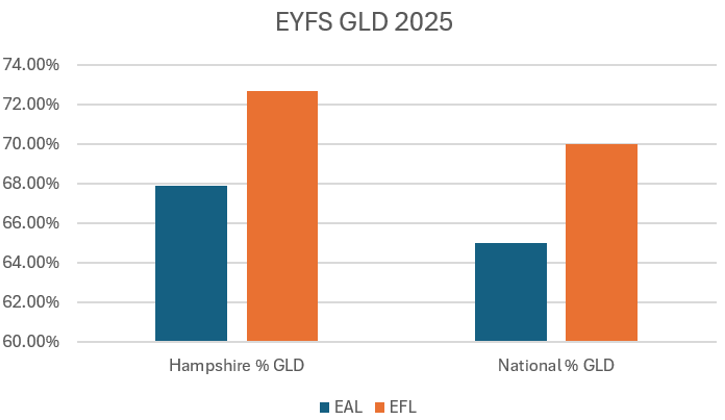
If we take these data on face value, then it is undeniable that our learners of EAL in the EYFS are doing less well than those who have EFL, 4.8% lower in Hampshire and 5% lower nationally. So what’s the story behind this attainment gap? Is it evidence of an early years curriculum that is not meeting the needs of multilingual children? Or something else?
We don’t believe that our learners of EAL are being failed by practice and provision within the EYFS. We believe we are looking at data which highlight that standardised measures and Age-Related Expectations (ARE) that are norm-referenced on a monolingual population do not always afford space for key contextual factors, in this instance a child’s language development in English.
Let’s think more reflectively about our multilingual children in the EYFS. Their skills in their first language/s are still in very early stages of development, and we know that developing an additional language works best when you have a firm foundation in first language/s (L1). Imagine being assessed in a language you had only recently begun to learn. Would the results accurately reflect your thinking, creativity and understanding of the world? Probably not. You would need time to develop vocabulary, make connections between concepts and language, and gain confidence in expressing your knowledge. What evidence do we have to support this? Let’s take a look at the outcomes data at the end of KS2. Looking at the graph below we see that in Hampshire 66% of learners with EAL achieved the Expected Standard at the end of KS2, 3.7% higher than Hampshire’s learners with EFL. Nationally the picture is almost identical, with 62% of learners with EFL and 66% with EAL achieving Expected Standard.
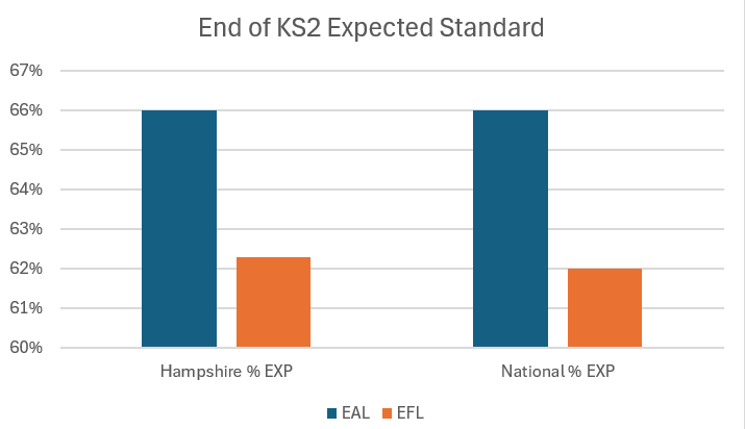
You can see that the picture has changed significantly by the end of Key Stage 2. By Year 6, Hampshire's multilingual learners are outperforming their monolingual, English-only peers. This raises an important question. If multilingual learners are succeeding later in their education, was the issue ever a lack of ability? If not their ability, then what?
The difference is not potential; the difference is time. Time to be fully immersed in a language-rich environment. Time for practitioners to get to know children and their families, building on the linguistic and cultural strengths they bring. Time to develop the child’s confidence in their new language whilst continuing to develop their other languages too.
This is why the EYFS remains such a crucial stage for multilingual learners. The goal should not be to accelerate children beyond their developmental readiness but to provide the language-rich, nurturing environment that allows them to flourish. When practitioners understand the process of learning through an additional language, the apparent attainment gap becomes less a story of underachievement and more a reminder that language development takes time. The challenge for schools is not to lower expectations but to recognise the journey multilingual learners are on and ensure that assessment data are interpreted through that lens.
Best EAL Practice in the Reception Classroom

Effective EAL teaching in Foundation Stage isn’t about simplifying learning. It’s about making it accessible. These principles support language development while maintaining high expectations.
Ensure that you are prioritising a language-rich environment. Young children learn language through exposure and interaction. Create a classroom filled with opportunities to hear and use English within meaningful, accessible and culturally familiar contexts that reflect children's experiences and backgrounds. Establish clear, consistent routines with repeated key phrases, and model language constantly (say, for example, “I am pouring the water”, “I am putting on my coat”).
Build vocabulary through songs, stories and play. Language is most effectively acquired when it is linked to real experiences and purposeful interactions such as cooking, role-play, construction activities, outdoor learning and shared story times. Draw on children's home languages, cultural experiences and prior knowledge where possible, for example through culturally familiar stories, celebrations, foods, artefacts and family photographs, helping children make meaningful connections between new English vocabulary and concepts they already understand and/or of which they have first-hand experience.
Multilingual learners benefit greatly from non-verbal communication. Use pictures, symbols and real objects. Demonstrate tasks rather than relying solely on verbal instructions and pair new language with actions. Visuals, gestures and actions are essential to reinforce meaning. Don’t shy away from including children’s other languages - plenty of content is available for free that enables those languages to be brought into the Foundation Stage environment.
Children often go through a “silent period” when they are absorbing language before speaking. This is normal. Support them by allowing time to listen and observe, accepting non-verbal responses (pointing, nodding, acting out) and avoiding pressure to speak before they are ready. Celebrate small steps - such as joining in with a repeated phrase or song.
A child’s home language can be a foundation for learning, not a barrier. Encourage families to use and maintain their first languages as this will help ensure their children develop skills in them too, skills which they can then transfer into English. Use dual language books, labels and greetings where possible to show that all children’s languages are valued in your setting. Effective collaboration between school and family is key to successful language development. Taking time to understand each child's cultural and linguistic background, and ensuring communication with parents is accessible and meaningful, helps foster a sense of belonging and supports positive learning outcomes.
Teachers working within the Early Years Foundation Stage should ensure that every child, regardless of language background, has the opportunity to thrive. Strong classroom practice allows Reception teachers to create environments where language differences become stepping stones rather than stumbling blocks.
Great EAL practice is simply great teaching - responsive, inclusive and child-centred. Having a strong understanding of early language development, foundation stage practitioners are well-placed to make a lasting difference in the lives of their youngest learners.
For further information on supporting multilingual learners in the Early Years and their families, please visit:
Families with children in the Early Years and Year R | Education and learning | Hampshire County Council
Guidance for Early Years/Year R settings | Education and learning | Hampshire County Council
Course: Early Years | EMTASMoodle
[ Modified: Tuesday, 20 October 2026, 10:08 AM ]